My mouth began to water as the spicy aroma of frying egg rolls filled the air at Thai Akha Cooking Class. Everyone gathered around, grouping closer, as our fearless leader showed us the correct direction to roll the wraps in the hot oil. With absolute certainty, I knew this would be an afternoon to remember.
After our amazing street food tours in Bangkok, we knew we wanted to do a cooking class in Chiang Mai, and the Thai Akha Cooking Class was our pick. What a fantastic choice!
Having taken over a dozen cooking classes in the past, I can wholeheartedly verify this was easily the best I’ve ever experienced.
Why Thai Akha Cooking School?
When looking up the cooking class options in Chiang Mai, and there are quite a few, we knew we wanted to find one that was a bit unique and supported some of the minority tribes. The Akha people are one of 12 different minority tribes in Northern Thailand. Their people originally migrated from China, Laos, and Myanmar in the early 1900s.
Back in the day, this country was known as Siam and was made up of several different kingdoms. Chiang Mai sits in the Lanna Kingdom, which ruled much of the north. In 1939, the country came together under one ruler, and the name was changed to Thailand. Thai means “free”, so Thailand is the “land of freedom”.
Because the country is relatively young, the Akha people did not grow up learning the Thai language. Jasmine, our guide on the culinary journey, grew up speaking Akha before learning Lanna, the language most common in the Chiang Mai region. She only learned Thai, and later English, when she began school.
The Market
We began the day with an iced coffee to go before walking across the old city to the local market, where we met our group at 9:00 am. Jasmine, our cookery guru, was easily the most organized and efficient woman I’d ever met.
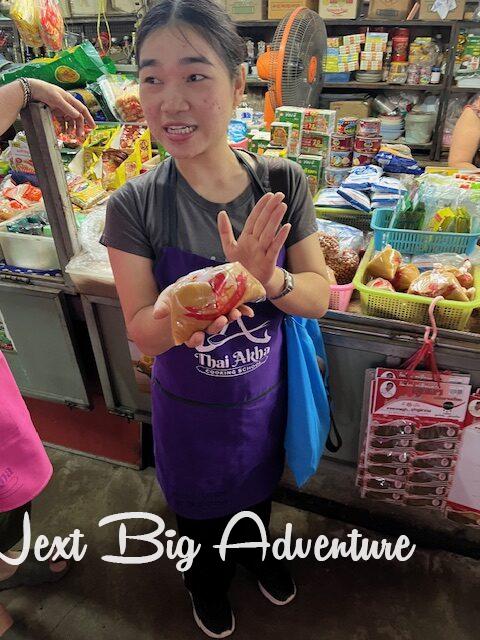
Jasmine led us throughout the market for nearly an hour, showing us some of the local delicacies for us to sample, and introducing some of the group to the common Thai ingredients.
Local markets are the gateway to understanding the soul of a country. We have spent endless hours in markets around the world, soaking in the ambiance, trying unfamiliar produce, and gawking in awe at the vast array of items that are such a world away from those at we find at home in the US.
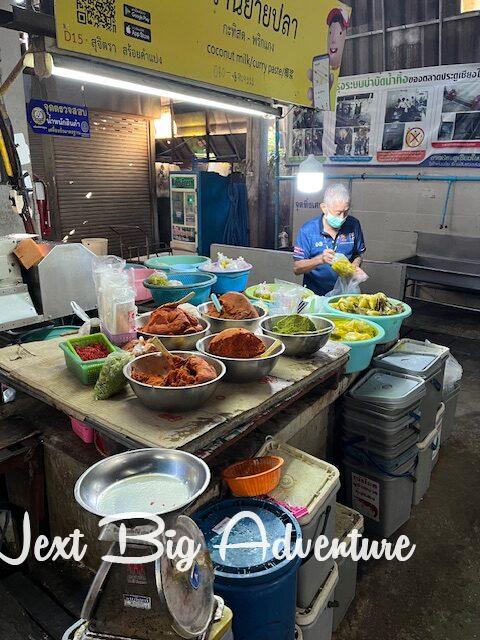
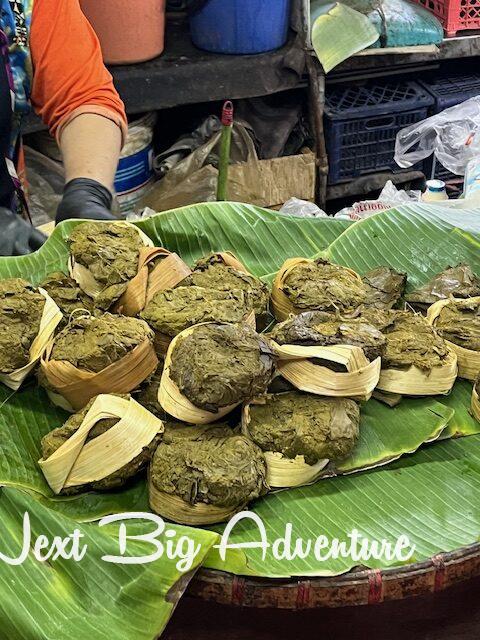
Although the four of us were comfortable with the normal Thai produce, one item on the market tour was totally new to us~ Quite frankly, it looked like elephant poop, but turned out to be Tom Khao Mud, which was quite a tasty snack filled with scented rice, herbs, coconut, and plantain.

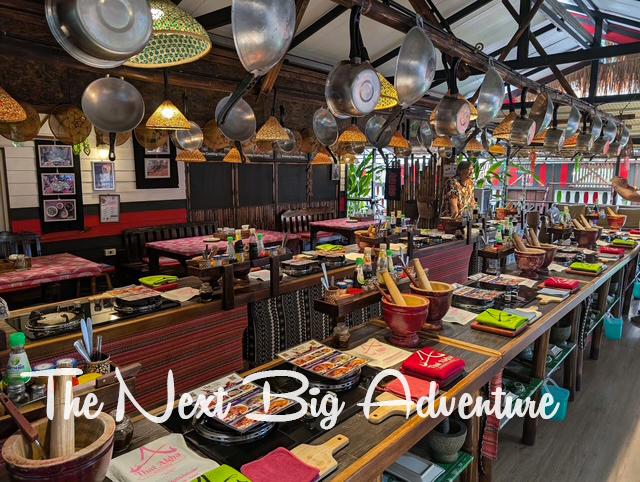
Climbing aboard our transport, we headed to the actual cooking school, which was a stunning setting, expertly set up with 16 individual stations. The school is colorful and festive, and a perfect setting to feel creative with cuisine.
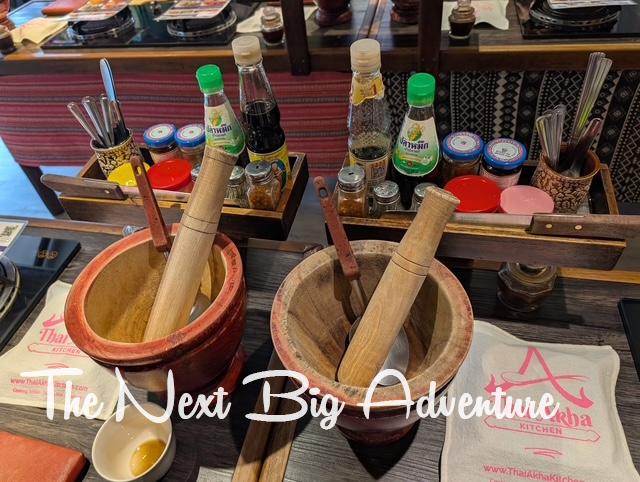
We were given aprons and a card with our cooking options for the class, and chose a station, ready to cook and eat really, really well.
On each station was a cookbook with a bit of history of the Akha people, and included all of the recipes that we’d be working on during our 4-hour class.
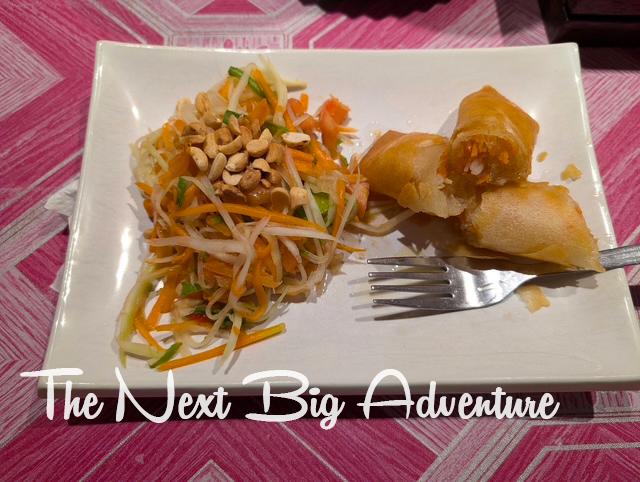
First up, Jasmine made two appetizers for the group. I think partially to get people comfortable in the setting, but also to explain some basic methods of preparation. The Green Papaya salad had been partially put together ahead of time, but the spring rolls were made during her presentation and were absolute perfection; crispy on the outside with a succulent filling. The Papaya salad was a great accompaniment to cool off the tongue.
Next up, we started on the dessert that would signal the finale of our meal. Mango Sticky Rice requires the rice to be soaked for four to five hours and then steamed for nearly an hour, a simple yet time-consuming dish. After the quick prep work, we headed to our stations to get to work.
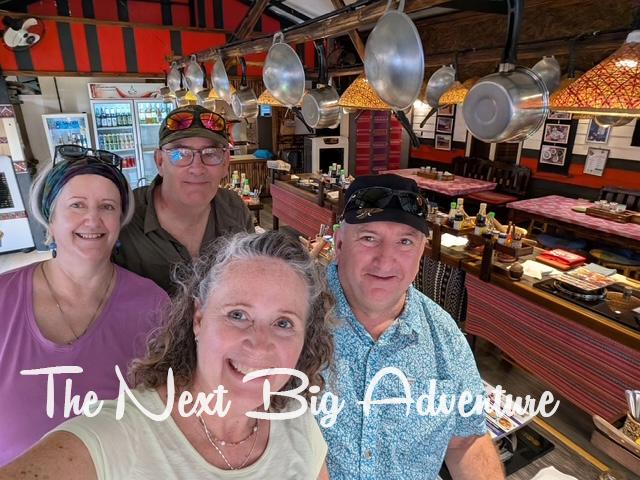
Time to Cook!
In place, we then got to choose what dishes we each wanted to prepare, and this is where Jasmine’s real magic came into play. Each of the 16 participants was able to choose one of four curries, one of four stir fries, and one of three soups.
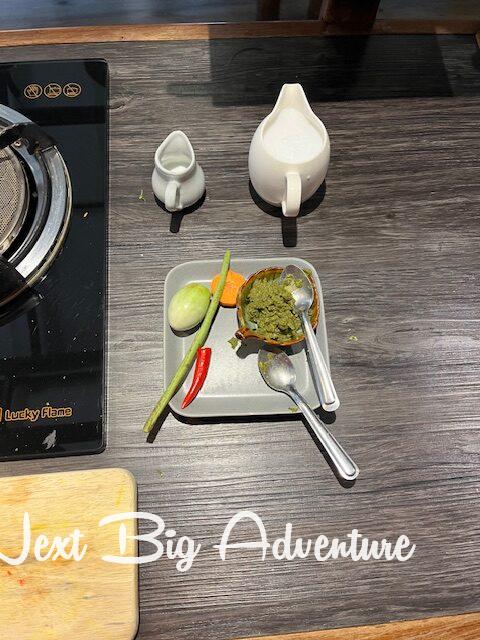
Obviously, with a group of four, we each choose one curry to start. The extraordinarily efficient staff brought the ingredients for the different types of curry: red, green, Panang, or Massaman to each one of our stations.
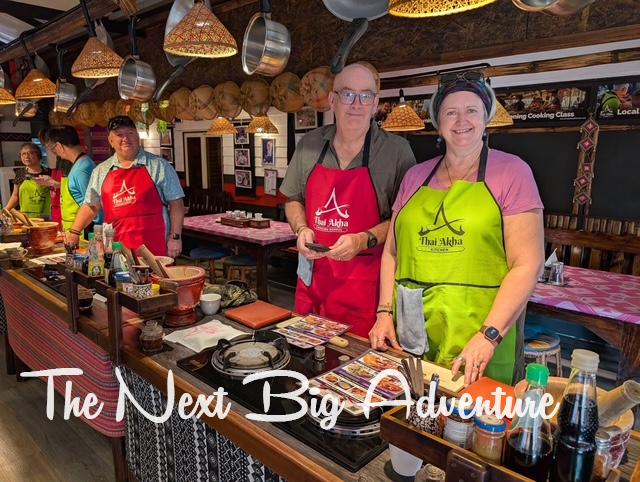
Jasmine walked us through how to make our curry paste before the actual preparation of each chicken curry. It was honestly a master class in organization to give directions for four different curries to 16 different participants with a wide range of experience.
Each curry was quite quick to prepare once the paste was prepared, and before long, we were sitting at several group tables learning about the others in the class, while enjoying the four different offerings. Our favorite? Perhaps the Panang Curry, for its unique flavor, which is less common in the US.
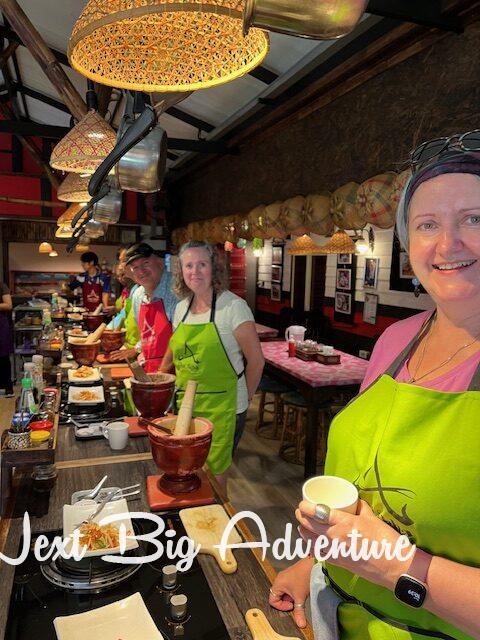
Bring out the Woks~ stir fry is on the menu.
Next up, we moved on to the stir-frys. Again, there were four options, so we chose between Thai Sweet & Sour, Cashew Nut, Holy Basil, and Pad Thai.
The process was the same as with the curry option, with Jasmine acting as our fearless leader, assisting with a tip here and there with those less familiar with Thai cuisine. The base spices were somewhat similar for all of the stir-fry, with each adding its own ingredient base to make the final dish.

Pad Thai is well-known in the US, but the highly unusual Holy Basil dish was a treat to be sure. Hot basil is a spicier version than we were familiar with, and also contained green beans among the ingredients, something we didn’t expect to find in Thai cooking.
Food completed, we retired to the tables, once again, to sample the dishes and chat with others in the class that included a couple and families from the UK. Belgium, South Africa, Montreal, and Korea.
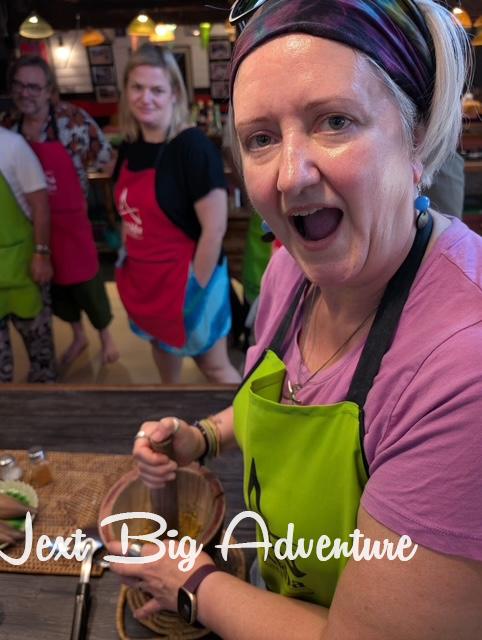
Time for Soup.
Although we were stuffed full at that point, it was time for soup!
There were three options, including coconut chicken soup, hot & sour prawn soup, and a tofu-noodle soup. Each of the soups were delicious in their own right, and each quite unique.
As we finished our soups, groaning in the exquisite agony of so much great food, we continued learning about the rest of the group and, as only true foodies do, began the discussion of what to have for dinner!
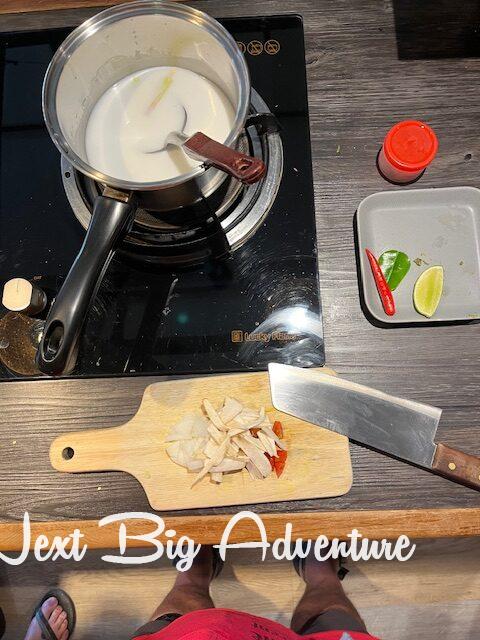
Thai people love sweets, and the adventure would not have been complete without two dessert options: pumpkin in coconut milk and mango sticky rice. The pumpkin dish was new to us, and quite delicious without being overly sweet. Mango sticky rice is a bit ubiquitous in Thailand, with the options ranging from simply okay to momentous, and this offering was sublime.
In the end, we reluctantly slipped off our brightly colored aprons, collected our possessions, and said our goodbyes.
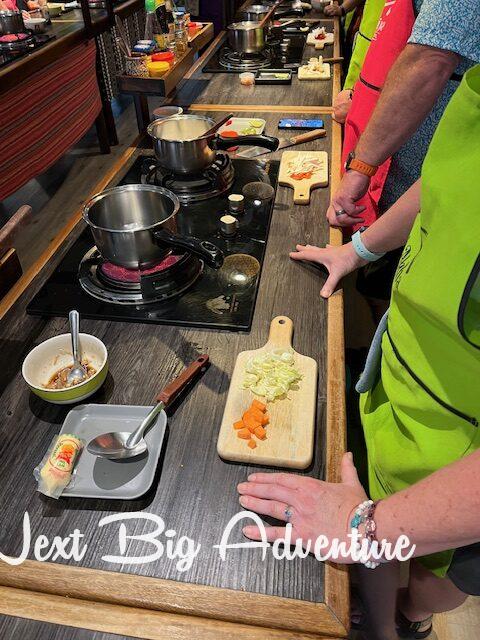
Jim was thrilled to have successfully navigated his first-ever cooking class, and the entire group felt a great deal of satisfaction at having created such delicious dishes.
Next time you’re in Chiang Mai, do yourself a favor and join in on a delightful and delicious day at Akha Cooking School.
We did the 6-hour morning cooking class (the 6 hours include travel time and the market visit) at a cost of 1400TBT ($43 USD) per person. Hotel pick-up and drop-off is included at hotels within the city walls and nearby.